
The European Union's Markets in Crypto-Assets Regulation (MiCA) has created the world's first comprehensive framework for crypto-assets. New data from the European Securities and Markets Authority (ESMA) shows how Europe's Electronic Money Token (EMT) market is taking shape, with clear patterns of regulatory compliance and geographic concentration.
Current Market: 26 Authorized Issuers Across Nine Countries
As of July 2025, ESMA's registry lists 26 authorized EMT issuers operating across nine EU member states. This modest number reflects both the regulatory complexity of EMT authorization and the early stage of the European digital currency ecosystem.
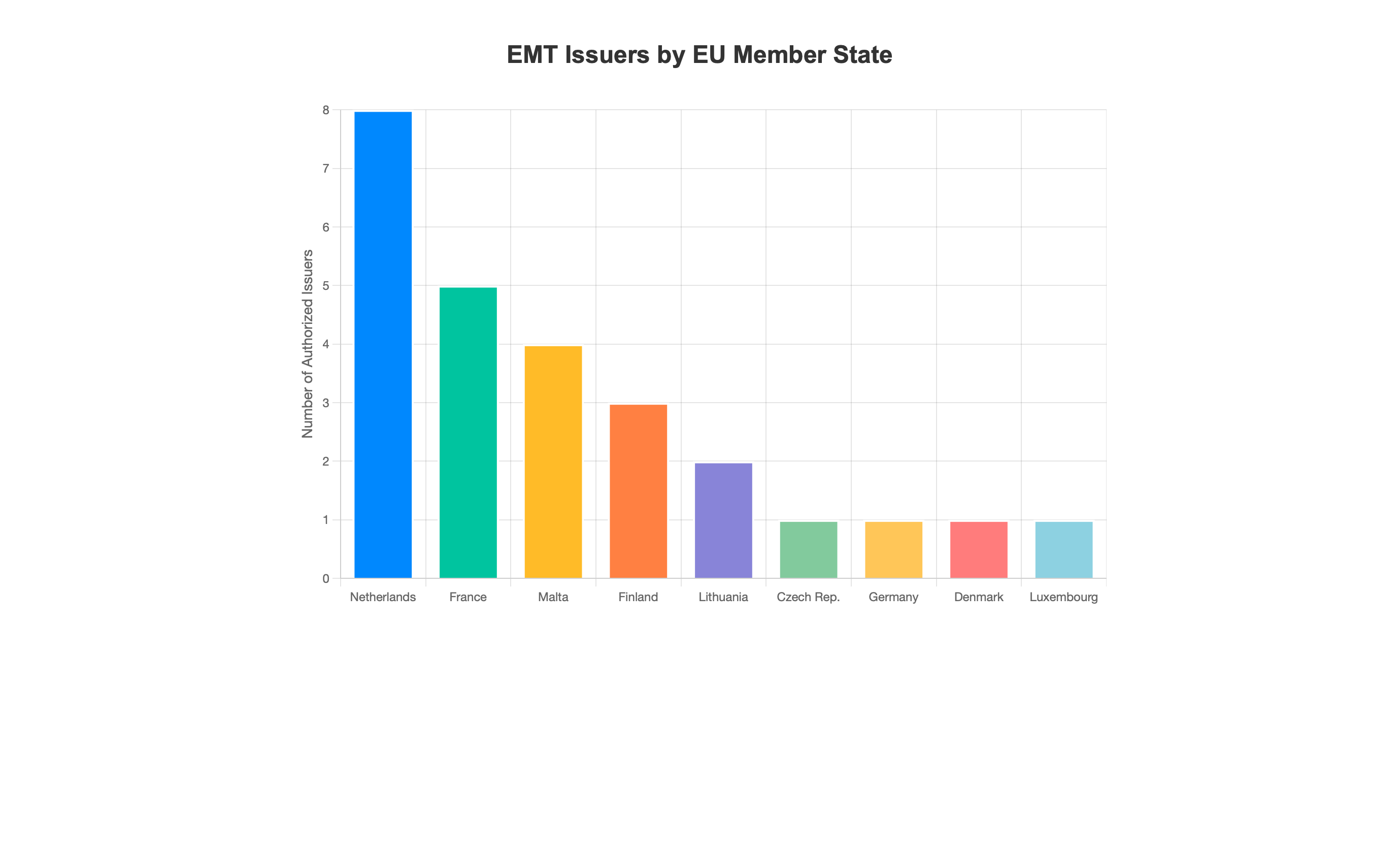
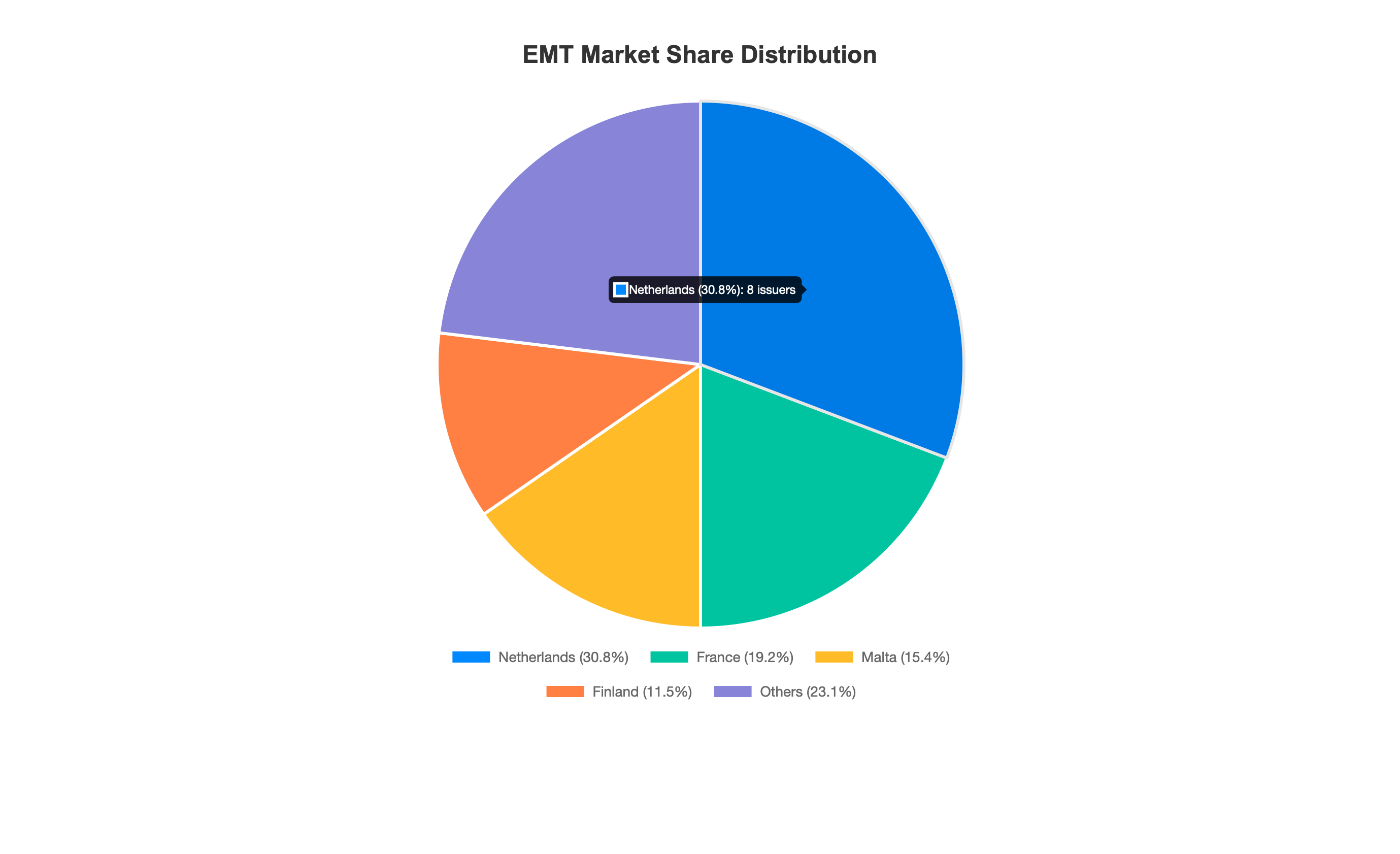
The data shows significant geographic concentration - the Netherlands has become the dominant hub for electronic money token operations. Dutch issuers account for nearly one-third of all authorized entities, with France and Malta serving as secondary centers.
Geographic Distribution and Regulatory Hubs
Netherlands: The Clear Leader
The Netherlands hosts eight authorized issuers (30.8% of the total), all supervised by De Nederlandsche Bank (DNB). This concentration reflects the country's fintech-friendly approach, established financial infrastructure, and clear regulatory guidance.
Dutch dominance extends beyond numbers. The clustering of EMT activity around Amsterdam creates network effects - companies benefit from shared expertise, regulatory clarity, and DNB's efficient supervisory approach.
France and Malta: The Runners-Up
France takes second place with five authorized issuers (19.2%), supervised by the Autorité de Contrôle Prudentiel et de Resolution (ACPR). This reflects France's broader fintech ambitions and government support for digital innovation.
Malta claims third position with four issuers (15.4%). Despite its smaller economy, the island nation's concentrated EMT activity demonstrates successful positioning as a crypto-friendly jurisdiction within the EU framework.
Nordic and Baltic Presence
Finland contributes three authorized issuers, while Lithuania adds two. These Nordic and Baltic entries show that MiCA's harmonized framework enables smaller EU economies to participate meaningfully in digital asset innovation.
The remaining countries - Czech Republic, Germany, Denmark, and Luxembourg - each host a single authorized issuer, indicating either early-stage market development or selective institutional entry strategies.
Authorization Timeline: The 2025 Wave
Historical data shows some issuers obtained electronic money institution licenses as early as 2017, but formal EMT authorization under MiCA is a recent development. The current year has seen notable acceleration, with multiple issuers receiving approval in 2025's first half.
Monthly distribution shows steady activity from February through July - a consistent application pipeline rather than a sudden rush. This pattern indicates thorough preparation by applicants and efficient processing by national authorities.
Regulatory Exemptions: Rarely Used
Only one issuer among the 26 authorized entities benefits from exemptions under Articles 48.4 and 48.5 of MiCA (3.8% of the total). This low rate shows that nearly all EMT issuers operate under full MiCA requirements - comprehensive authorization procedures, capital requirements, and ongoing supervisory obligations.
The limited exemption use suggests either few issuers qualify for narrow exemption criteria, or companies prefer the regulatory certainty of full authorization. The single exempted issuer, Stable Europe, operates under the "limited network exception," serving a defined ecosystem rather than the general public.
White Paper Compliance: Mixed Adoption
MiCA requires EMT issuers to publish comprehensive white papers. While most authorized issuers fulfill this transparency obligation, several entities are marked as "EMT_NO_WP," indicating pending publication or exemption status.
This variation reflects different development stages across EMT projects and the complexity of preparing documentation meeting MiCA's disclosure requirements. White papers serve as crucial investor protection, ensuring EMT holders access detailed information about token economics, risks, and operations.
Supervisory Authority Distribution
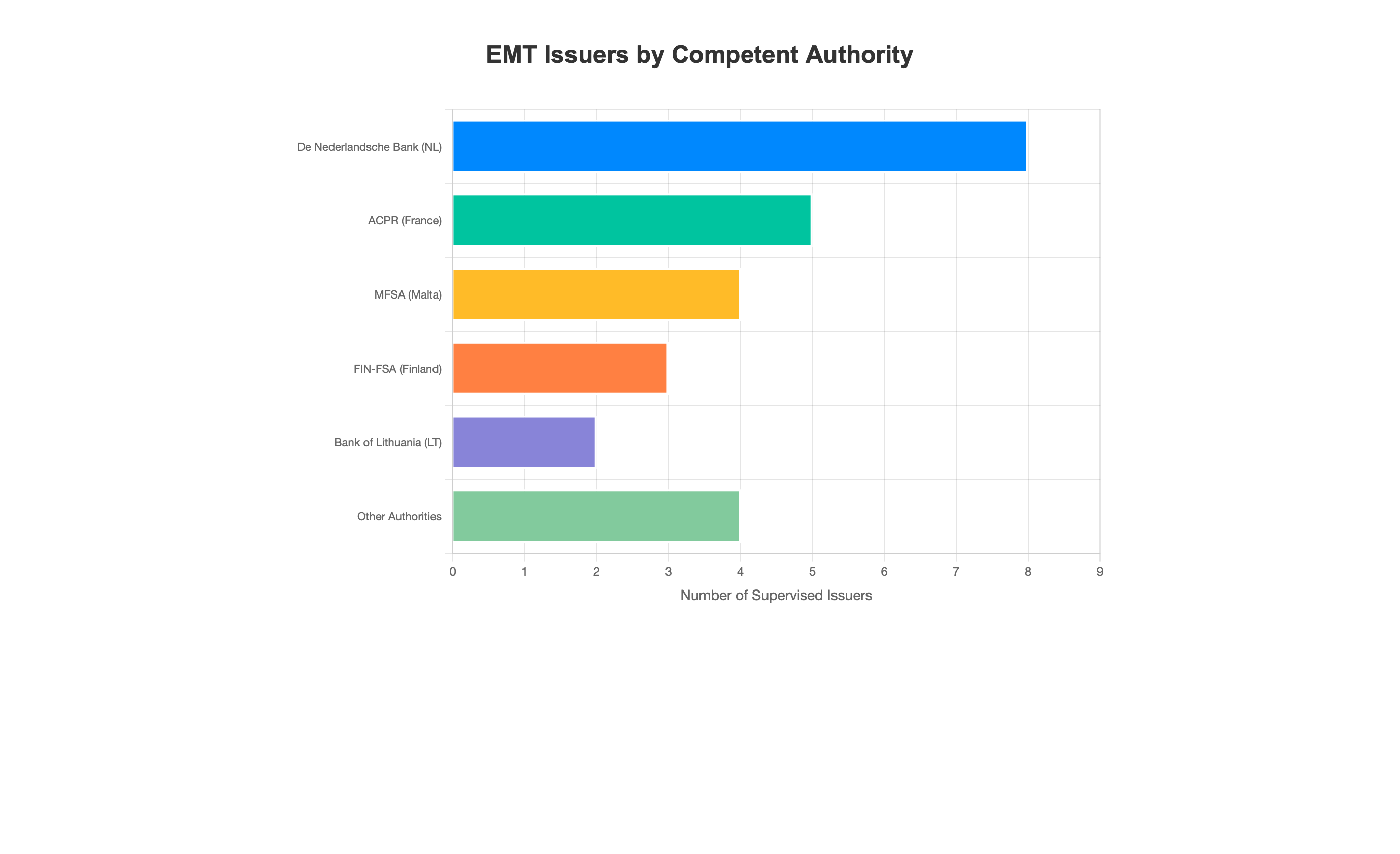
De Nederlandsche Bank leads with eight supervised entities, followed by France's ACPR (five) and Malta's MFSA (four). This concentration indicates certain national authorities have developed specialized EMT supervision expertise, creating competitive advantages in attracting issuers.
The pattern also reflects varying approaches to MiCA implementation, with some authorities proving more efficient in authorization processes. This raises questions about regulatory competition within the EU's single market - while MiCA provides harmonized rules, national implementation can create meaningful differences in authorization experiences.
Market Structure Analysis
Scale and Concentration: With only 26 authorized issuers across the entire EU, the EMT market remains highly concentrated. This suggests either high MiCA entry barriers or cautious market entry by potential issuers.
Geographic Clustering: Activity concentration in specific jurisdictions creates EMT hubs benefiting from network effects and specialized regulatory expertise. This clustering may become self-reinforcing as companies seek proximity to peers and specialized services.
Regulatory Standardization: Uniform MiCA application across jurisdictions, evidenced by low exemption rates, shows successful EU harmonization of EMT regulation. This should facilitate cross-border operations and reduce regulatory arbitrage.
Competitive Dynamics
Early EMT authorization under MiCA confers significant competitive advantages. With limited authorized issuers, first movers benefit from reduced competition and ability to establish market position before additional entrants receive authorization.
Geographic distribution indicates different market entry strategies. Countries like the Netherlands and France attract multiple issuers, suggesting vibrant local ecosystems. Others, with single issuers, may represent strategic market entries seeking favorable regulatory environments.
Financial Innovation Implications
Institutional Confidence: Formal authorization processes and compliance requirements increase institutional confidence in EMT products, potentially accelerating adoption by traditional financial institutions and corporate treasuries.
Cross-Border Integration: MiCA's passporting framework allows authorized EMT issuers to operate across all EU member states, facilitating pan-European digital payment solutions and reducing single market fragmentation.
Innovation Constraints: While regulatory clarity provides certainty, comprehensive MiCA requirements may constrain innovation by smaller fintech companies lacking resources for complex authorization processes.
Future Development Factors
Regulatory Maturation: As national authorities gain EMT supervision experience, authorization processes may become more streamlined, potentially increasing new market entry pace.
Technology Advances: Developments in blockchain technology, interoperability solutions, and digital identity systems could expand EMT use cases, attracting new issuers and applications.
Global Competition: Europe's regulatory-first EMT approach contrasts with more permissive frameworks elsewhere. Long-term competitive implications remain to be determined.
Key Insights
ESMA's EMT registry data provides valuable insights into Europe's regulated digital asset market beginnings. With 26 authorized issuers across nine countries, the market remains concentrated but shows steady growth signs. The Netherlands' emergence as the leading EMT hub, combined with significant French and Maltese activity, suggests specialized regulatory clusters are forming.
While MiCA provides regulatory certainty and consumer protection, it also creates meaningful entry barriers favoring well-resourced and strategically positioned companies. The success of Europe's EMT framework will be measured not just by authorized issuer numbers, but by the innovation, efficiency, and consumer adoption these regulated tokens achieve.
The foundation has been established - the next phase will determine whether Europe's regulatory approach successfully balances innovation with stability in digital assets.
---
Analysis based on ESMA's EMT issuers registry data as of July 2025.